
Nikro Air Duct Cleaning in White Rock: A Homeowner’s Guide
Most homeowners in White Rock evaluating a duct cleaning quote learn nothing about the equipment that will actually show up. They hear “truck-mounted unit” and “industry-standard vacuums” and have no way to tell whether the tools match the claims. Nikro is one brand you can check. Its negative-pressure units are built to defined CFM and filtration standards, and knowing what those standards mean gives you a way to judge any contractor, whatever name is on the machine.
What Makes Nikro Equipment Different From a Shop Vac?
Nikro builds negative-pressure machines for source removal, the process of pulling debris out of ductwork rather than blowing it around. A consumer vacuum and a generalist’s rented rig both fail at that job for the same reason: they move too little air and filter their exhaust poorly, so fine particulate ends up back in the room. A Nikro unit is engineered around three things that matter in White Rock homes running long cooling seasons: HEPA-rated exhaust filtration, high-CFM airflow that stays strong down a full trunk line, and dual-motor configurations for large residential systems with more square footage and more branch runs than a single-stage unit can reach.
Here’s why the numbers behind a Nikro unit matter in practice:
- HEPA-rated exhaust filtration. Return air passes through the machine, not just the hose. Filtration is what keeps the dust you paid to remove from settling back on your furniture.
- High CFM at the far end of the run. Airflow drops as distance and turns eat into it. A machine with real capacity at the work end pulls debris toward the nozzle instead of leaving compacted material in the ducts.
- Dual-motor capacity. Larger systems need the extra pull to hold negative pressure while a technician works a single branch.
You don’t need to memorize model names. You need to hear a contractor describe the machine’s airflow and filtration in plain terms and understand the answer. A company working with professional-grade equipment from Rotobrush and Nikro can tell you what the machine does and why it chose it. A company that can’t name a single tool is asking you to trust a claim with nothing behind it.
Rotary Brush vs. Flexible Rod: Why the Method Matters on Flex Duct
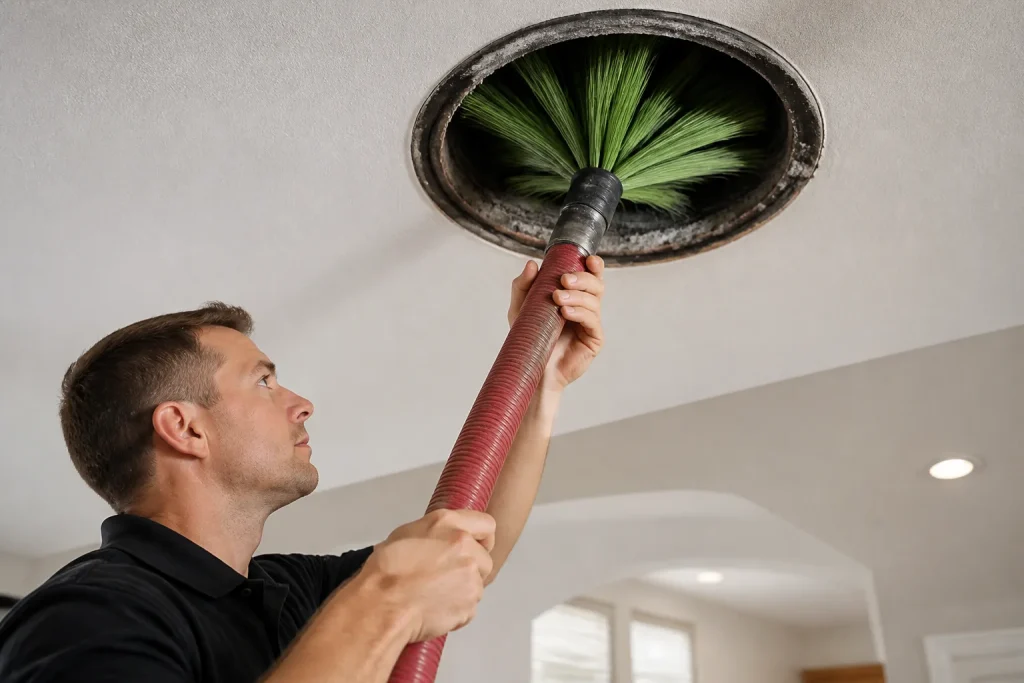
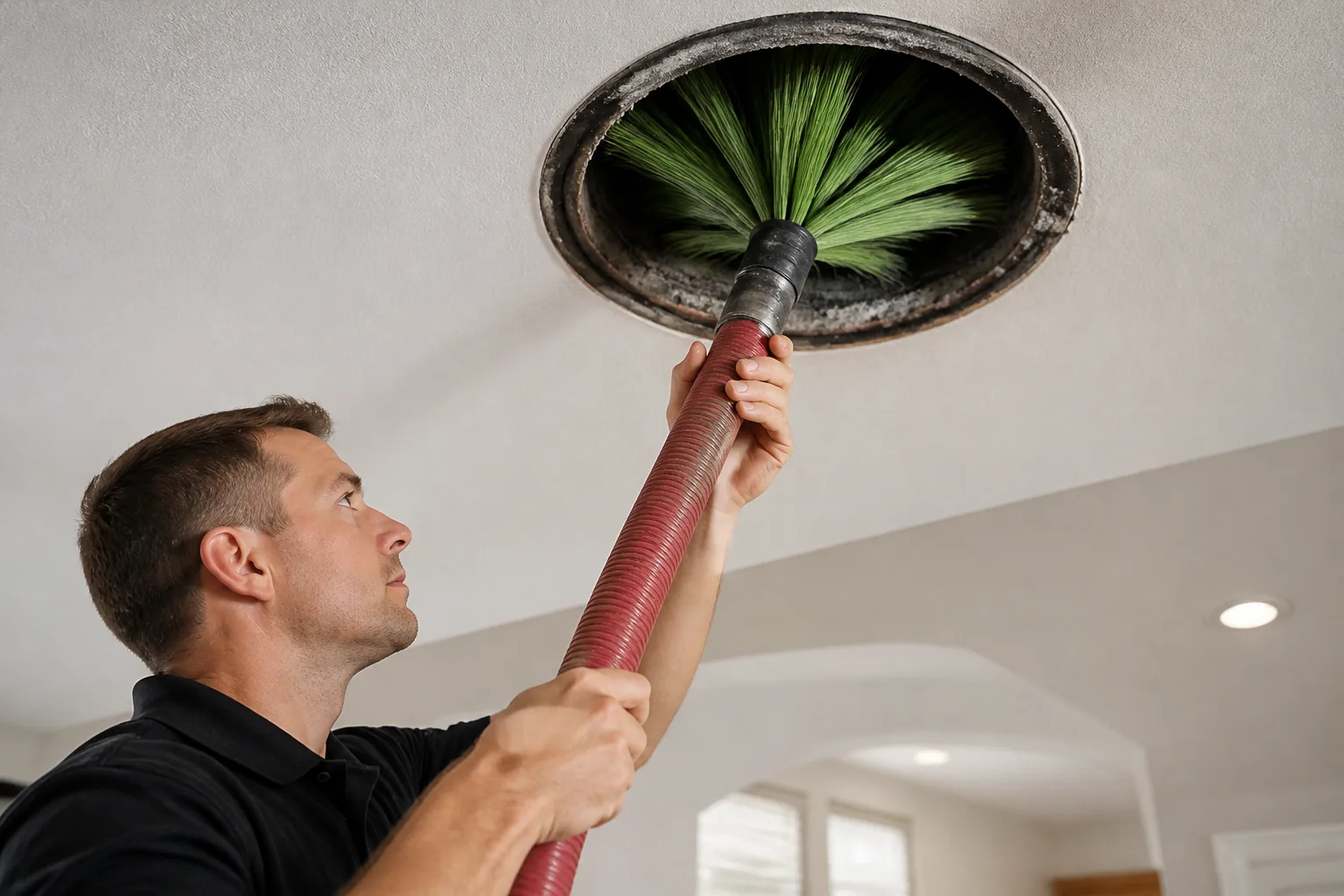
The cleaning head is where duct work actually gets done, and on flexible duct the choice of head matters more than any other part of the job. Nikro rotary brush systems agitate the duct wall with a spinning action that scrubs and dislodges compacted debris. Flexible rod systems, common with less-specified equipment, depend on a whipping motion to knock material loose. On flex duct the second method is a real risk: the rod can catch, score the interior liner, or damage the wire helix that gives the duct its shape. A torn liner turns a clean duct into a leak.
Why this matters for the air you breathe:
- Compacted debris clings to the wall. On flex duct, lint, dust and skin cells press together against a slightly textured surface. Surface-only suction leaves a film behind.
- Mechanical agitation loosens what suction can’t move. A rotary head brushes the wall while the vacuum pulls the loosened material out, capturing it in one pass.
- Liner protection is the whole game. A duct with an intact liner stays efficient. A duct with a scored or torn liner leaks conditioned air into a crawl space or attic and pulls dirty air back in.
When you evaluate a bid, ask which brush system the contractor uses on flex runs. The answer tells you whether they’ve thought about the material, or just about the invoice.
How Do You Verify a Duct Cleaning Job Was Actually Done?
Verification is the part of duct cleaning most homeowners never think to ask about, and equipment brand is your best pre-job check. A Nikro-equipped scope should include work that a lesser-equipped job often skips. Here’s what to look for before anyone touches your ducts in White Rock:
- Air handler compartment cleaning. The blower compartment and evaporator coil cabinet collect dust like everything else. Dedicated small tools and a controlled vacuum reach where a truck hose can’t. If a contractor scopes cleaning to the ducts alone, ask why the air handler is excluded.
- Negative pressure verification by zone. Air should flow toward the vacuum, not out of it. A technician confirms each zone is under negative pressure before work begins, so debris moves to the machine, not into the room.
- HEPA-filtered exhaust. The exhaust filter catches what you don’t want to breathe. A machine with unrated exhaust filtration moves dust out of the duct and into your home.
- Before-and-after photo documentation. Photos of your own ducts, not a stock image, are the cheapest proof a contractor can offer.
In our experience, a job that includes these four steps runs longer than a quick blast of air. That’s a sign of completeness, not inefficiency.
Why Equipment Transparency Is a Credibility Test in This Trade
Duct cleaning has no licensing requirement that proves skill behind a machine, so a homeowner has to look for markers of accountability. Equipment transparency is the most reliable one. A contractor who can name their machines and describe CFM, filtration standard, and brush system is running a system they can be questioned about. A contractor who speaks only in vague terms is running a system you’ll never be able to check. The brand matters less than the specificity. Some contractors use a professionally built unit from a maker you’ve never heard of and describe its specs precisely. That’s a good sign.
For a deeper look at what an equipment-backed job should look like, our page on air duct cleaning walks through the process step by step.
Here’s the shortlist of what to ask regardless of the brand name on the machine:
- What’s the CFM rating of your negative-pressure unit?
- What filtration standard does your exhaust filter meet?
- What brush system do you use on flex duct, and how do you protect the liner?
- Do you clean the air handler compartment, or only the duct runs?
- Do you verify negative pressure in each zone before starting?
You don’t have to know the “right” answer to each question. You need to hear a specific one. Evasion is the tell.
When Equipment Alone Isn’t Enough: Repair, Sealing, and the Whole System
Cleaning removes what’s in the ducts. It doesn’t fix why the ducts were dirty in the first place. Loose joints, disconnected runs, and torn liners leak conditioned air, pull unfiltered attic or crawl space air into your returns, and let a home in White Rock send its cooled air into a space nobody lives in. That’s why a proper job should include Duct Repair & Sealing when inspection finds a structural problem. Fixing the leak is the completion step most cleaning-only crews skip.
Whole-system thinking means the duct runs get vacuumed with the right brush for the material, the joints get sealed, and the indoor air quality side gets addressed too. This is where air-quality hardware from Honeywell, Aprilaire, and Abatement Technologies earns its place, because those products bring commercial-grade filtration and fresh-air control into a residential system. The company’s scope also covers dryer vent cleaning (a genuine fire risk if lint builds up), HVAC cleaning for the equipment side, and sanitizing with Guardsman-grade products after the debris is gone, so the clean surfaces stay clean. One call covers the system from the return grille to the dryer vent to the air handler. For a full view of the five-service scope, start at Air Duct Cleaning White Rock.
Your Likely Repairs: Matching Equipment to a White Rock System
Most homes in White Rock run a conventional forced-air setup, which means the questions are straightforward. The system has a return, a filter, an air handler, a coil, and a set of supply runs. Duct cleaning is not one process but several, each tied to a different piece of equipment. Understanding the match helps you judge what you’re paying for.
- Air Duct Cleaning uses the negative-pressure machine and rotary brush head to clear the trunk and branch runs.
- Dryer Vent Cleaning uses a separate vent brush and airflow tool to clear the lint line that feeds the dryer.
- HVAC Cleaning uses hand tools and a controlled vacuum to clean the blower, cabinet, and coil surfaces.
- Air Quality & Sanitizing uses Guardsman-grade products for post-clean protection and odor control.
- Duct Repair & Sealing uses sealing materials to fix the leaks that made the filters work harder in the first place.
If you’d rather hand the whole system to someone who brings the right machine for each task, call (855) 337-2035. We answer 24/7. Fast dispatch from 7am to 7pm, Sunday through Friday. Our technicians have up to 12 years of experience.
The Bottom Line
Equipment brand is a window into how a contractor works. Nikro’s negative-pressure units are built to specific airflow and filtration standards, and a job that uses them properly includes air handler cleaning, negative-pressure verification per zone, protected brush work on flex duct, and HEPA-filtered exhaust. Ask any contractor to name their CFM, their filtration standard, and their brush system. The quality of the answer, not the name on the machine, tells you whether the crew is equipped to do the job correctly.
If you’re in White Rock and need help, Air Duct Cleaning White Rock offers free estimates. Call (855) 337-2035. You’ll get a written estimate that sets the price before work starts, not a surprise after it does.
Frequently Asked Questions
Nikro air duct cleaning refers to using Nikro-built negative-pressure equipment, designed for source removal, rather than lighter generalist units. The difference shows in HEPA-rated exhaust filtration, higher CFM airflow down long trunk lines, and dual-motor capacity for large systems. The equipment is the reason the debris actually leaves the ducts instead of getting loosened and left behind.
You don’t need Nikro specifically. What you need is equipment built to the same standards: rated exhaust filtration, real airflow at the work end, and a brush system designed for flex duct. Rotobrush is another professional-grade brand with comparable capability. Ask about specs, not just the name. If the contractor can’t describe their machine in specifics, look for one who can.
Ask three questions: the CFM rating of your vacuum unit, the filtration standard of your exhaust filter, and the brush system used on flex duct. A contractor who answers in specifics is accountable. A contractor who dodges is a signal to look further. You don’t need to know the right answer; you need to hear a clear one.
Clean them, then seal them if inspection finds leaks or a damaged liner. Cleaning removes debris; sealing stops the same thing from happening again. A crew that offers both can diagnose the system and complete the job. If you’re unsure, ask for a written assessment before work starts.
Written by the team at Air Duct Cleaning White Rock.
Need Air Duct Cleaning Help?
Call Air Duct Cleaning White Rock - the local pro we connect you with is licensed and insured, with free written estimates in White Rock.
(855) 337-2035